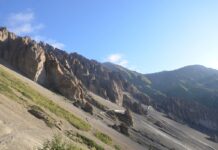
Til Bahadur Pariyar, a resident of Marpha in ward 2 of Gharapjhong Rural Municipality in the mountain district of Mustang, complained that snow leopards killed 60 of his mountain goats over the last three years.
A few months ago, he lost three horses to a common leopard, which has been moving into the mountainous region lately due to the warming climate.
“Earlier, we only had to guard our livestock against snow leopards, but now common leopards also kill our animals,” complained Pariyar. “Many livestock farmers have already abandoned the profession due to the growing threat from predators—snow leopards and common leopards.”
Nepal is among the 12 countries that are home to snow leopards and has committed to protecting the species, its prey, and its habitats. However, rising temperatures caused by global warming have made protecting endangered species, such as snow leopards, a big challenge.
The country has witnessed extreme weather events over the past decade and a half. According to a 2017 study by the Department of Hydrology and Meteorology (DOHM), Nepal’s average annual maximum temperature has risen by 0.056 degrees Celsius. The study shows most districts have witnessed increasing temperatures each year, with hill and mountain districts witnessing a faster rise compared to the Tarai districts.
“Protecting livestock—mountain goats, horses, mules, and yaks—has become increasingly challenging for farmers in Mustang and other mountain districts, which have been hardest hit by the climate crisis,” said Lal Bahadur Gurung, an expert on snow leopards. ‘‘The rising temperatures have increased incidents of human-wildlife conflicts in mountainous regions, and livestock are getting killed by both common and snow leopards.”
It is estimated that there are around 400 snow leopards in Nepal out of fewer than 4,000 worldwide.
Experts say snow leopards sometimes raid livestock barns during heavy snowfalls when prey becomes scarce, especially as they age and become weak. During such raids, they kill dozens of animals at once. Also, rising temperatures due to climate change are driving common leopards to higher altitudes, further increasing the threat to livestock.
Multiple stakeholders have set up mechanisms to protect endangered species like snow leopards by reducing human-wildlife conflicts. But affected livestock farmers complained that these efforts only add to their misery.
“I got nothing from anyone—not from the insurance company, the local government, or any of the agencies involved in snow leopard conservation,” complained Santosh Pariyar, another resident from ward 2 of Gharapjhong Rural Municipality who lost 27 mountain goats in a snow leopard attack. “The insurance company wanted photos of the snow leopard carrying off my goats, along with tags as proof. Local officials asked me to show where the dead goats were buried.”
Many livestock farmers the Post spoke to voiced similar frustrations, saying the mechanisms meant to reduce human-wildlife conflicts are overly problematic and too mechanical, which is fuelling growing resentment towards snow leopards.
“Who would not be angry when dozens of livestock are killed at once,” said Anil Adhikari, executive director of the Teka Samuha Nepal, a non-profit that runs a community-based snow leopard conservation project in six local units in Mustang.
“Unless we make the mechanisms set up for lessening human-wildlife conflict more farmer-friendly and provide compensation on time, we cannot expect the intended results.”
Adhikari claimed that retaliatory killings of snow leopards, which used to be a major challenge to conservation efforts, have declined thanks to years of awareness efforts. He also said that farmers’ growing frustration with the authorities’ lackadaisical approach to compensation is a lingering issue.
“Getting compensation from insurance companies and other authorities concerned is too difficult,” said Niraj Thakali, a local from Jomsom, Mustang. “First of all, most herders cannot gather all the required proof—photos of the leopard attack, insurance tags, and so on. Second, the compensation amount is so small that selling the meat of the dead animals is often more profitable than filing an insurance claim. And even when you file a claim, it takes months to receive the payment.”
Thakali, an activist involved in snow leopard conservation, said that he too lost three horses a few months ago, but chose not to file an insurance claim, as he knows it is not easy to complete all bureaucratic procedures.
“There is a growing awareness among locals that we shouldn’t kill snow leopards, even if they prey on our livestock,” said Sabi Thakali, a local from Thini village in ward 5 of Gharapjhong Rural Municipality in Mustang. “The authorities need to step up and provide compensation promptly, if they want us to continue protecting these animals.”